 Add to Chrome
 Add to Firefox
 Add to Edge
AndroidDaily: A Verifiable Benchmark for Mobile GUI Agents on Real-World Closed-Source Applications
May 26, 2026
The rapid development of GUI foundation models and mobile GUI agents has spurred numerous evaluation benchmarks, yet most rely on simulated environments or open-source applications, leaving real-world closed-source applications largely unevaluated. The core difficulty is that closed-source applications do not expose internal states, making traditional automatic verification inapplicable. To bridge this gap, we introduce AndroidDaily, a large-scale benchmark comprising 350 realistic daily-use tasks across 94 high-frequency Android applications spanning transportation, shopping, local services, entertainment, content creation, social media, and everyday utilities. To enable automatic and verifiable assessment in these opaque environments, we propose Guideline-grounded Reviewer for Automatic Diagnostic Evaluation (GRADE), a process-aware evaluator built on a three-tiered system of observable external guidelines: operational obligations, output quality, and negative constraints. GRADE tracks the agent's visual trajectory against these criteria and produces step-level diagnostic judgments, turning long-horizon, open-ended mobile interactions into verifiable evaluation without relying on hidden internal states. Experiments show that GRADE achieves 87.37\% agreement with human evaluators. The strongest model reaches a 62.0\% success rate on AndroidDaily, highlighting a substantial gap between current reasoning capabilities and practical execution in realistic mobile workflows.

STEP3-VL-10B Technical Report
Jan 15, 2026We present STEP3-VL-10B, a lightweight open-source foundation model designed to redefine the trade-off between compact efficiency and frontier-level multimodal intelligence. STEP3-VL-10B is realized through two strategic shifts: first, a unified, fully unfrozen pre-training strategy on 1.2T multimodal tokens that integrates a language-aligned Perception Encoder with a Qwen3-8B decoder to establish intrinsic vision-language synergy; and second, a scaled post-training pipeline featuring over 1k iterations of reinforcement learning. Crucially, we implement Parallel Coordinated Reasoning (PaCoRe) to scale test-time compute, allocating resources to scalable perceptual reasoning that explores and synthesizes diverse visual hypotheses. Consequently, despite its compact 10B footprint, STEP3-VL-10B rivals or surpasses models 10$\times$-20$\times$ larger (e.g., GLM-4.6V-106B, Qwen3-VL-235B) and top-tier proprietary flagships like Gemini 2.5 Pro and Seed-1.5-VL. Delivering best-in-class performance, it records 92.2% on MMBench and 80.11% on MMMU, while excelling in complex reasoning with 94.43% on AIME2025 and 75.95% on MathVision. We release the full model suite to provide the community with a powerful, efficient, and reproducible baseline.
Step-GUI Technical Report
Dec 19, 2025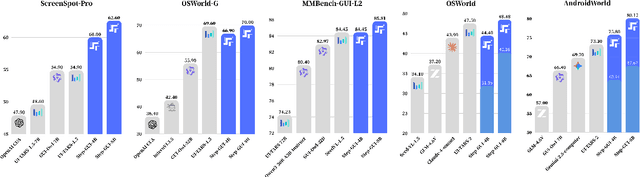
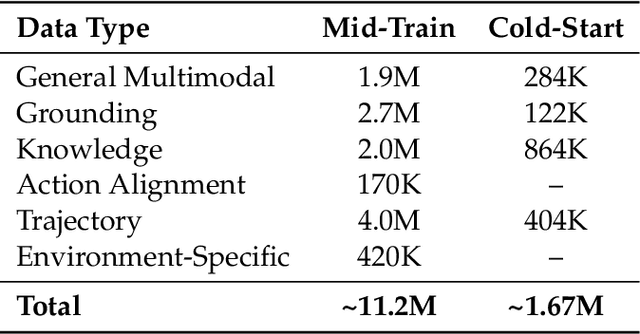
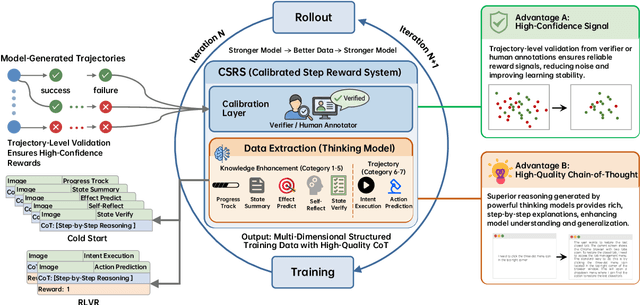
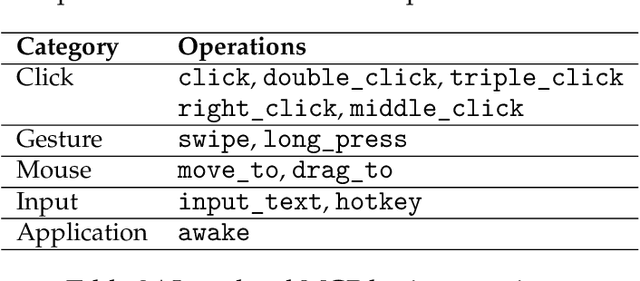
Recent advances in multimodal large language models unlock unprecedented opportunities for GUI automation. However, a fundamental challenge remains: how to efficiently acquire high-quality training data while maintaining annotation reliability? We introduce a self-evolving training pipeline powered by the Calibrated Step Reward System, which converts model-generated trajectories into reliable training signals through trajectory-level calibration, achieving >90% annotation accuracy with 10-100x lower cost. Leveraging this pipeline, we introduce Step-GUI, a family of models (4B/8B) that achieves state-of-the-art GUI performance (8B: 80.2% AndroidWorld, 48.5% OSWorld, 62.6% ScreenShot-Pro) while maintaining robust general capabilities. As GUI agent capabilities improve, practical deployment demands standardized interfaces across heterogeneous devices while protecting user privacy. To this end, we propose GUI-MCP, the first Model Context Protocol for GUI automation with hierarchical architecture that combines low-level atomic operations and high-level task delegation to local specialist models, enabling high-privacy execution where sensitive data stays on-device. Finally, to assess whether agents can handle authentic everyday usage, we introduce AndroidDaily, a benchmark grounded in real-world mobile usage patterns with 3146 static actions and 235 end-to-end tasks across high-frequency daily scenarios (8B: static 89.91%, end-to-end 52.50%). Our work advances the development of practical GUI agents and demonstrates strong potential for real-world deployment in everyday digital interactions.